Svenska:
Den här webbplatsen kan endast nås som arkivreferens. De officiella webbsidorna för avdelningen för partikelfysik finns på http://particlephysics.physics.lu.se
Sidan nedan slutar uppdateras fr.o.m. 2020-09-22 och uppfyller endast delvis tillgänglighetsdirektivet. Se tillgänglighetsredogörelsen
English:
The webpage you reached is made available for archiving purposes only. The official division of particle physics webpages can be found at http://particlephysics.physics.lu.se
The page below is not updated any longer since September 22, 2020 and does not conform completely to the accessibility regulation. See the accessibility statement


Next: Saturations
Up: Hardware Modifications
Previous: Hardware Modifications
To increase the luminosity for LEP a minibunch scheme was put into operation in the beam during 1995. The LEP ring accelerator and its four experiments cannot easily support more than 4 bunches(8 with the opposite going positions) in the ring at the same time. There is also a limit on how many electrons that can be squeezed into a bunch, which led to the attempt to split each bunch into several minibunches.
This naturally put new constraints on the detector electronics, as different timings were needed for different minibunches. Without going into too much detail a fastbus card called LURFB [3] was constructed in LUND containing 'add on' electronics. Minimal changes of the existing electronics was desired as it is working with few or no spare parts. The main function of the card is to find the signal peak for each minibunch and adjust a time gate to read out the VSAT signals properly. It also provides the minibunch number and the time development from the FAD signals.
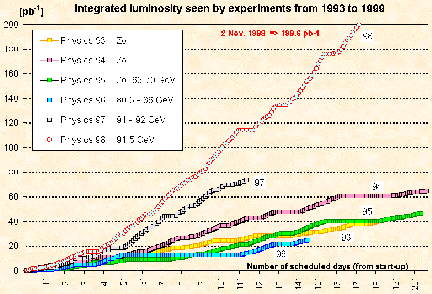
For LEP I operations the minibunch scheme was quite successful and the new LURFB worked fine after some initial problems. When LEP raised the beam energy during 1996 they immediately ran into problems with the minibunch optics. Stable beams were hard to obtain and low currents in the bunches resulted in that the minibunch scheme was abandoned for the high energy data. The luminosity for each year is shown above and the problems can clearly be seen in 1996. From the VSAT point of view this failure to obtain minibunches for the high energy data was however a fortunate thing as the next section will point out.
Next: Saturations
Up: Hardware Modifications
Previous: Hardware Modifications
Andreas Nygren
1999-11-11