


VSAT electronics were build and adjusted for LEP I energy(45 GeV) to obtain the best and most accurate results. To achieve the best energy resolution, signal amplification was pushed close to the higher region of the available signal space(0-255). When the beam energy was increased two things happened, the first effect was however hidden by the second and could not be discovered until one year later(see below).
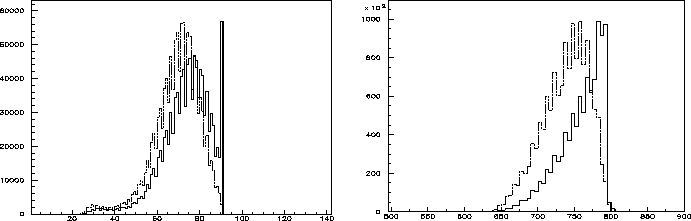
The visible problem was that the signals started to saturate on the shower maximum of the FAD-planes, piling up the signal in bin 255(fig 2.1). The solution for this was to change some of the pre-amplifiers and readjust some amplifiers in later stage in the electronics(on the MUX-cards). The pre-amplifiers are located inside the detector and cannot be changed during data taking, so this was done during the winter shutdown 96/97.
The amplifiers on the MUX-cards were then normalized to a test-in signal. When data taking started for 1997, the pile up in bin 255 had indeed disappeared. The pulse shapes still did not look quite satisfactory however, the upper tail of the signal peak was missing(fig 2.2). The electronics did not seem to respond fully to the signal in fad planes located at shower maximum(3,4 and 5).
 |
To investigate this the VSAT electronics were set up to trigger only on one single fad-plane(normally four-2,3,4 and 5). With the help from the flash ADC signal output from the LURFB card an 'oscilloscope' picture could be taken of the signal propagation from that fad plane. This could be done as a 24 bit word of the flash ADC time development is put in the VSAT data stream. Data were taken for each of the different critical fad-planes for different timing of the HOLD signal to the electronics. During our exercises half of the detector was still operational as usual, to provide LEP with the off-momentum electron background rate.
It turned out that the cause of the problem is that our pre-amplifiers have different peaking time for different energies. Sending a HOLD too fast would result in that the pre-amplifiers do not have enough time to rise to the correct value. If the hold is sent later, the signal starts dropping again after the peak has been reached(especially for low energies). The FAD timing was changed from 5.55 to 5.80 microseconds, resulting in about 15% lower FAD signal.
Changing the timing also has another implication however, we need to send a fast hold in order to separate the minibunches. With a timing of 5.80 microseconds this is not possible and we can only reliably take one minibunch data. Fortunately, as mentioned before, LEP decided not to run with more than one minibunch during LEP II operations, so VSAT is in the clear(for the moment). For special short alignment runs at the Z0-peak, two minibunches are still used and VSAT can then only use half of the available data.