


The main purpose for VSAT has changed from being a detector for luminosity measurements at the Z0 peak, to instead measure background conditions and to be an instrument for gamma-gamma physics. The cross section for tagging electrons from two-photon collisions decreases with the distance to the beam. It was therefore decided to ask for a decrease of the beam pipe radius with 5mm in the x-direction in order to improve the acceptance. This would boost the gamma-gamma event rate with a factor two approximately [4], as well as increase the bhabha cross section with about 50%(see fig 2.3).
Manufacturing a new beam pipe and replacing the old can only be done by the LEP collaboration. After convincing everybody that the beam aperture will not be harmed during injection, it was finally decided to replace the beam pipe. All the small angle taggers for all the four experiments at LEP got this very late upgrade, even though the idea originally came from the VSAT group long before. Unfortunately there was some mistake made when the new beam pipe was constructed and the VSAT did not get quite the requested decrease. Only one module got 5 mm closer, while the others got between 3 and 4 mm. One of the beam pipes was also not made elliptical but instead conical, which is of course not desirable.
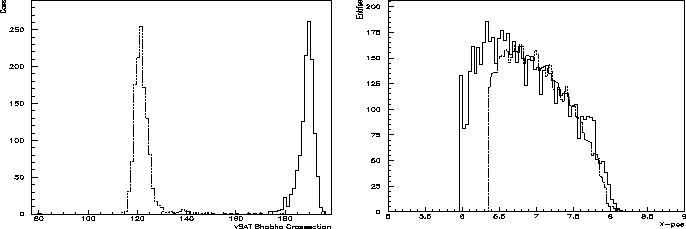 |
As the outer part of the VSAT is shadowed by a fixed flange, movement of the detector closer to the beam extends the active area. The upgrade therefore resulted in an extra gain of the detector coverage(fig 2.4). This increase of detector area in a region with high cross section naturally means much higher trigger rate from the detector. This resulted in some troubles both online and offline, as the next section and chapter will point out.