As mentioned in chapter one the VSAT detector has a local trigger system with the ability to store several VSAT events between two DELPHI events. Local VSAT(and other detectors) events are called T1 triggers, whereas DELPHI events are called T2. After this there are even higher stages of online event cuts(T3 and T4), VSAT does however keep all the information and none is thrown away. This means that we also can have several T2 triggers within a T3 trigger.
VSAT has three types of triggers - bhabha, single electron and delayed bhabha as described in chapter one. The delayed bhabha trigger was removed at the beginning of LEP II, as it was producing too high T1 trigger rate. Due to this there is no longer a direct measurement of the false bhabha background and it has to be estimated afterwards from the single electron rate, as will be described in chapter 4.
The decrease of the beam pipe size heavily increased our bhabha and background rates, the VSAT T1 trigger started to increase again and our local buffer became full more frequent. When this happens VSAT sends a forced T2 and triggers the whole DELPHI detector, which then normally only contain garbage.
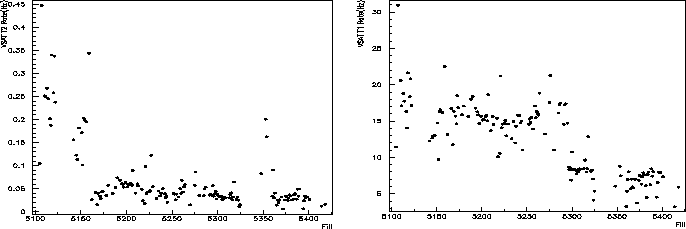
During the later part of 1998, DELPHI started to suffer from some dead time due to high T2 rate. The STIC bhabha trigger was down scaled by a factor two at fill 5048 and focus was turned to the VSAT T2 trigger, that started to become annoying for DELPHI with rates around 0.3-0.4 Hz. To cure this problem the VSAT buffer length in the FDDP was increased from 12 to 20 events from fill 5162, and the VSAT T2 rate(fig 2.5) went down with a factor 5-8(depending on which time during the fill). The extra peak around fill 5350 is a result of that the buffer length was by mistake set back to 12 again.
To improve the situation further, DELPHI also down scaled the VSAT T1 trigger with a factor two at fill 5296(fig 2.6). At the first glance this worked fine as the T1 rate and event readout went down by a factor two. The VSAT disk capacity was at its limit, which led to that the down scaling was kept throughout the year. After some more careful analysis it turned out that not all of the VSAT electronics could handle the T1 down scaling and that the T2 rate sent to DELPHI did not change noticeable(fig 2.5). In the future the T1 will therefore not be down scaled and the buffer length will be increased to 25.
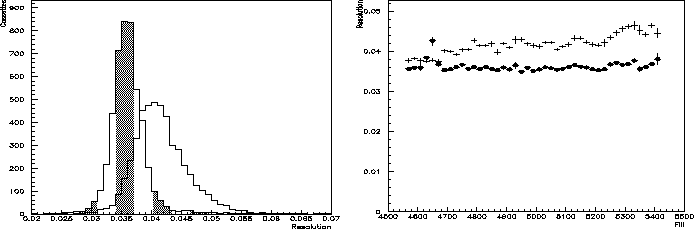
Higher trigger rate also means higher amount of radiation that hits the detector, with increased radiation damage as a result. This is noticeable especially in the outer modules, where the single electron rate is much higher. The single electrons are the most common events, but is down scaled about 1000 times to make up only about 10% of the readout triggers. The resolution in the FAD-plane energy reconstruction is shown both for inner module 2 and outer module 3 in figure 2.7 and 2.8. The sudden increase in module 2 in the beginning of the year is due to a temporary loss of one fad-plane. The outer modules clearly suffers somewhat of radiation damage, but will not reach critical values during the remaining time of the experiment.
 |