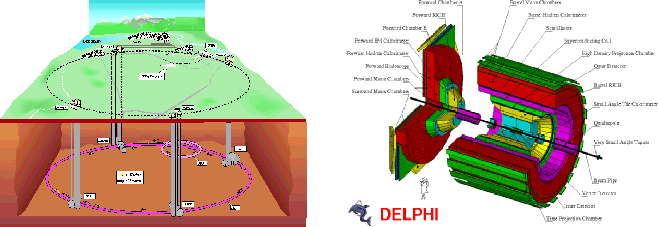
The DELPHI(Detector with Lepton, Photon and Hadron identification) detector(fig 1.2) is situated in a cavern about 100 meters under ground, the deepest point in the 27 km long LEP ring tunnel. It is a cylindrical detector with a length and a diameter around 10 meters. The detector was built with a special emphasis put on particle identification, as the name suggests. Enclosing the interaction point is a vertex detector, consisting of three cylindrical silicon strip layers giving it a instrict R resolution of about 8
  m. The inner and outer layer is also equipped with double sided strip detector in order to cover the z coordinate, which can be reconstructed with an average resolution of about 18 m.
Surrounding the vertex detector there is a tracking and triggering detector called the inner detector. It consists of a cylindrical drift chamber between 12 and 22 cm, which is enclosed by two concentric trigger layers at 23 and 28 cm. The main tracking device in DELPHI is the time projection chamber(TPC), which enclose the inner detector. It is divided in two parts, each having a length of 134 cm and a outer radius of 116 cm. Outside the TPC resides the last tracking detector(The Outer Detector), followed by the calorimeters(HPC,HAC and MUS).