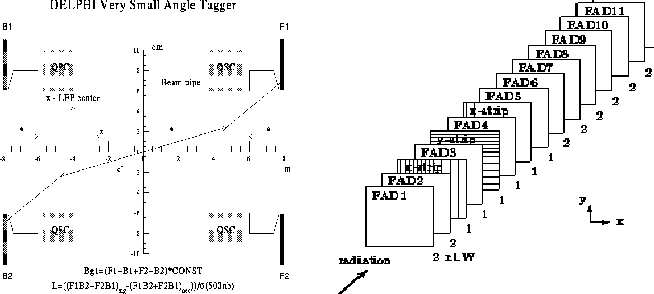
7.7 m from the interaction point(fig 1.3). Each module consists of 11 FAD(=Full Area silicon Detector) for energy measurement, interspaced with two radiation length thick tungsten layers. For shower positioning there are two X-strip planes and one Y-strip plane at shower maximum(fig 1.4).
The active area is limited on the inner edge by the beam pipe at around 6 cm and by a flange shadowing the detector at around 8.3 cm on the outer edge. This would result in an angular coverage between about 8 and 11 mrad, but due to a defocusing quadrupole in front of the detector the angular coverage is instead between 5 and 7 mrad. There is an error in the exact geometry which prevents the VSAT from making an exact absolute luminosity measurement, instead the luminosity is normalized to STIC for different periods of running.
The DELPHI detector has a common trigger system and events are read out for all detectors together. VSAT was designed to give fast online measurement of background and luminosity, as it profits from the higher cross section at small angles. It has therefore been equipped with a local trigger system that stores each event in a buffer, which is read out and emptied by a DELPHI event. If the buffer becomes full the VSAT sends a T2 signal and triggers the whole DELPHI detector.
During LEP I(1989-1995) the VSAT had three types of triggers - bhabha, single electron and a delayed bhabha trigger. A bhabha event is defined as the small angle scattering of an electron and positron hit. A bhabha trigger is thus a signal in two diagonal modules at the same time. The single electron trigger is fired, when an off momentum electron reach the detector and triggers one of its modules. There is also a possibility of an accidental coincidence of two off-momentum particles hits, which is triggered as a bhabha. To measure this rate, the VSAT was equipped with a delayed bhabha trigger, which is a single hit in one module and another in the diagonal module at the next bunch crossing.