


The most direct way to investigate the probability of having an off-energy electron in a VSAT module is to count them and compare the number to the number of bunch crossings during the same period. The VSAT detector is hit by an enormous quantity of off-energy background electrons, so, in order to save disk-space for more interesting processes, only a small fraction of these events are read out.
 |
The VSAT is also equipped with scalers that count the number of hits in each module and the number of Bhabha triggers. The scaler values can be used offline to estimate the probability of background in an individual modules. Since the scalers count all events, the Bhabha scaler value was subtracted to get the true number of single electrons.
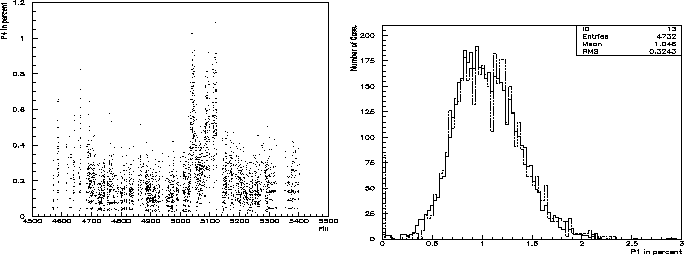
The beam and vacuum conditions vary during the year, which alters the VSAT background rate. This is shown in Figure 1, where the probability of a single electron in module 4 have been calculated for each cassette and plotted against the fill number. The increase between fill 5050 and 5100 is due to a LEP vacuum leak.
The full line in Figure 2 shows the probability distribution of single electrons in module 3, as calculated from the scalers on each cassette of 1998 data and Table 1 gives the probability of an off-energy electron in VSAT averaged over all the 1998 data.
Off-energy electrons coinciding with Bhabha events can be used to measure both the probability and the energy and position distributions of this background. The dotted line in Figure 2 shows the probability of each cassette having an electron in module 3 at the same time as a pair of Bhabha electrons in module 1 and 4.
 |
In this study an energy cut of 15 GeV on the electron in module 3 was made, since this corresponds to the cut in the trigger used by the scalers. The cassettes were required to contain at least 3000 Bhabha events, which reduced the number of cassettes from 4700 to 1600. The distribution in Figure 1 from Bhabha events has therefore been rescaled so that it can be compared to the distribution from the scalers. The two methods seems to be in perfect agreement, with the probability of an off-energy electron in Module 3 varying between 0.2-2.3% .
|
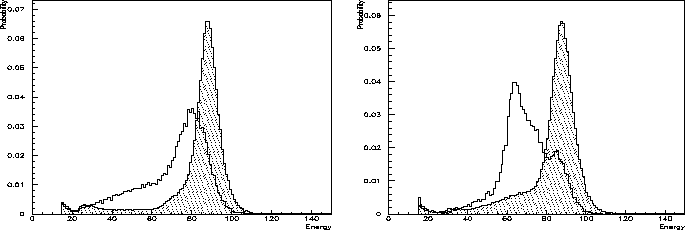
From the energy distributions of the off-energy electrons (Figure 3 and Figure 4) the probability of an off-energy electron in VSAT as a function of an energy-cut can be calculated. The energy is not properly calibrated in the XSDST data and the data used here are taken from the VSAT offline processing with all the corrections applied. The background in the outer modules (1 and 3) has a higher energy as it is produced in a region further away from DELPHI [3]. The probabilities of an off-energy electron in the four VSAT modules are given in Table 2 and are calculated from a sample consisting of 47.5 . 106 Bhabha events, of which 578782 events had an additional off-energy electron in VSAT with energies higher than 15 GeV.
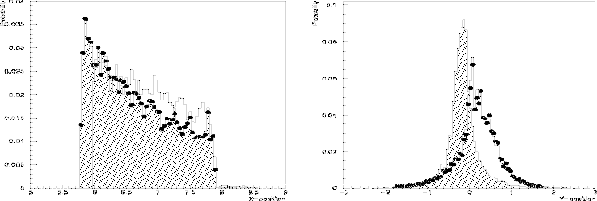 |
The best way of removing the background is by a cut on the position of the showers, since the background is concentrated in the horizontal plane. The x and y distributions of the single electrons are shown for both inner and outer modules in Figure 5 and 6. In the outer modules the y-distribution has a sharp peak since it is produced closer to DELPHI. A comparison was made of the position distributions with the single electrons NOT in coincidence with a Bhabha event. This sample contains more events although it has been downscaled. These distributions are shown as dots in Figure 5 and 6 and are in a good agreement with those obtained from the Bhabha events.
|
 15 GeV.
 1[%]
1[%] 0.00002