


A sample of
e+e-  Z0(n
Z0(n ), Z0
), Z0 
 events was also selected to study the probability
of having off-energy electrons in VSAT.
In this study the 1998 data2 was
used and the selection criteria was optimised
with the help of a KORALZ4.2 [4] Monte Carlo sample3.
events was also selected to study the probability
of having off-energy electrons in VSAT.
In this study the 1998 data2 was
used and the selection criteria was optimised
with the help of a KORALZ4.2 [4] Monte Carlo sample3.
To suppress the background, which was mainly due to cosmic muons, it was required that:
 < 125 GeV.
 -
-  | - 1800| < 30.
 max(pT
 , pT
, pT ).
).
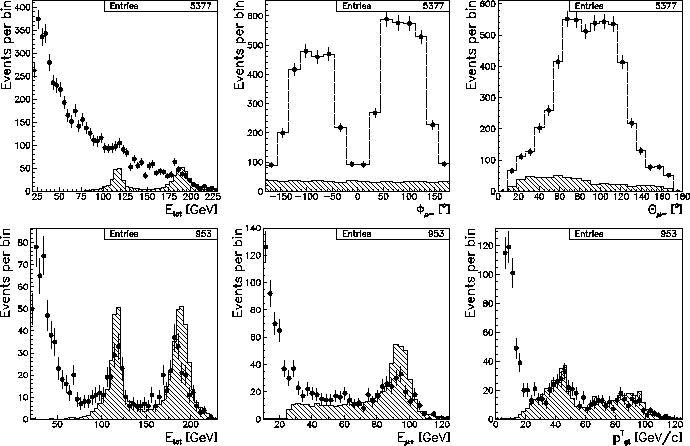 |
The upper three plots in Figure 7 show the distributions
of
Etot,  and
after
conditions 1, 2 and 3 were satisfied. At this stage 4741 events
remained, with 495 expected. The angular distributions
had broad peaks at
and
after
conditions 1, 2 and 3 were satisfied. At this stage 4741 events
remained, with 495 expected. The angular distributions
had broad peaks at

 900 and around
 =
=  900
which were not predicted by Monte Carlo. The reason is of course the
large contamination of cosmic muons. Many of the cosmic
events can be rejected by the requirement on the primary vertex
(condition 4). The bottom three plots in Figure 7
depict the distributions of
Etot, E and pTgt
after the vertex cut. 800 events remained in the data with an unchanged
number of expected events.
900
which were not predicted by Monte Carlo. The reason is of course the
large contamination of cosmic muons. Many of the cosmic
events can be rejected by the requirement on the primary vertex
(condition 4). The bottom three plots in Figure 7
depict the distributions of
Etot, E and pTgt
after the vertex cut. 800 events remained in the data with an unchanged
number of expected events.
The last cut on pTgt removes softer muons coming
from
e+e-  (n), ,
collisions or
Z0
(n), ,
collisions or
Z0 
 events. After this cut
36919 events remained in the data, with
40873 expected from the Monte Carlo study (the second
error is due to the uncertainty in the cross section).
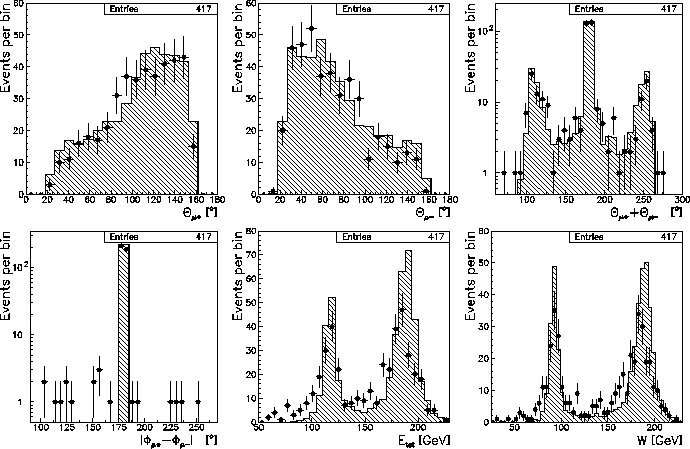
Good agreement between data and predictions was obtained, as
can be seen in Figure 8, which shows different
angular distributions such as the polar angle of each muon
(
events. After this cut
36919 events remained in the data, with
40873 expected from the Monte Carlo study (the second
error is due to the uncertainty in the cross section).
Good agreement between data and predictions was obtained, as
can be seen in Figure 8, which shows different
angular distributions such as the polar angle of each muon
(
 ), the sum of polar angles
(
), the sum of polar angles
(
 + ) and the difference
in azimuthal angles (
| - | ).
The total energy (
Etot = E + E ) and invariant mass of the muons
(
W =
+ ) and the difference
in azimuthal angles (
| - | ).
The total energy (
Etot = E + E ) and invariant mass of the muons
(
W = 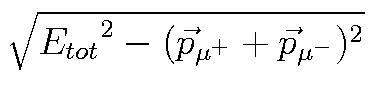 ) are
also presented in Figure 8.
The overall impression from the data-Monte Carlo comparison is that the
efficiency is somewhat too high in the simulation and that the
energies are slightly high.
) are
also presented in Figure 8.
The overall impression from the data-Monte Carlo comparison is that the
efficiency is somewhat too high in the simulation and that the
energies are slightly high.
 |
Out of the 417 selected events, only 18 had an electron in the VSAT. In all of these events, only one module scored a hit. The energy measured by VSAT was corrected using the offline VSAT programs. The total probability and probabilities for each module derived from this sample are shown in Table 3.
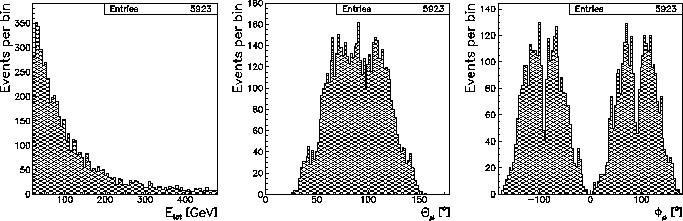
 and
and
 for events fulfilling conditions 1-4.
 [%]
[%]