Svenska:
Den här webbplatsen kan endast nås som arkivreferens. De officiella webbsidorna för avdelningen för partikelfysik finns på http://particlephysics.physics.lu.se
Sidan nedan slutar uppdateras fr.o.m. 2020-09-22 och uppfyller endast delvis tillgänglighetsdirektivet. Se tillgänglighetsredogörelsen
English:
The webpage you reached is made available for archiving purposes only. The official division of particle physics webpages can be found at http://particlephysics.physics.lu.se
The page below is not updated any longer since September 22, 2020 and does not conform completely to the accessibility regulation. See the accessibility statement


Next: VSAT background in STIC
Up: Background in VSAT
Previous: Dimuon events
The cosmic muon events, rejected in the previous analysis,
can also be used to look for off-energy electrons in VSAT. The following
cuts were made to select the events:
- Two muons had to be found, with no
other particles in the event. The muons should be identified as
``very loose'' or better.
- The energy of each muon had to fulfil
E
 > 10 GeV.
- Neither of the two muons should come from the primary vertex
( Q(LPV+4)
 0 ).
0 ).
- It was required that
|
 +
+  - 1800| < 10 and
||
- 1800| < 10 and
|| -
-  | - 1800| < 10
where n and m can be a positive
| - 1800| < 10
where n and m can be a positive  or a
negative
or a
negative  .
.
After this selection,
5396 events were found, 337
pairs, 336
and 4723
events.
Distributions of
the total energy of the muon pair (Etot) and of
the azimuthal angle (
 ) and polar angle (
)
of the individual muons are shown in Figure 9.
) and polar angle (
)
of the individual muons are shown in Figure 9.
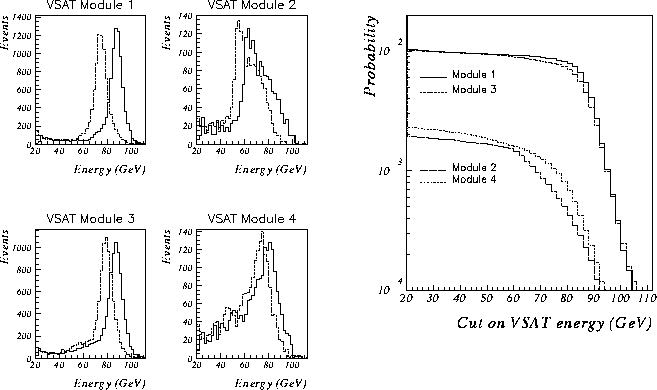
Of the 5396 events, there was one VSAT off-energy electron in 136 events
and two off-energy electrons in 5 events. The probability of an
electron in VSAT computed from these events is presented in Table 4.
Figure 10:
Left: Energy distribution of the showers in the four VSAT modules.
The dotted line shows the uncorrected and the
full line the corrected spectrum.
Right: The probability that an off-energy electron shower will be found
in VSAT, as a function of an energy cut.
 |
Next: VSAT background in STIC
Up: Background in VSAT
Previous: Dimuon events
Andreas Nygren
1999-11-17