


A sample of back-to-back Bhabha events in STIC was selected by requiring
a single shower in each calorimeter with
2.5o <  < 8o
and
0.97 < Ee/Ebeam < 1.05. The angle between the two showers was
required to be larger than
179.85o. In all, 925445 events
from the 1998 data satisfied these requirements, 22433 of them having
at least one shower in VSAT with an energy larger than 20 GeV.
Most of the events (22072) had a shower in only one module,
while a small fraction had a hit in two (359) or three (2) modules.
< 8o
and
0.97 < Ee/Ebeam < 1.05. The angle between the two showers was
required to be larger than
179.85o. In all, 925445 events
from the 1998 data satisfied these requirements, 22433 of them having
at least one shower in VSAT with an energy larger than 20 GeV.
Most of the events (22072) had a shower in only one module,
while a small fraction had a hit in two (359) or three (2) modules.
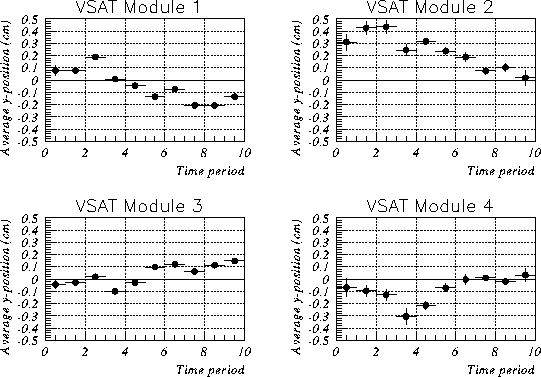 |
Figure 10 shows the energy distribution of the showers seen in the four VSAT modules. The energy spectrum is shown both directly from the XSDST and after offline corrections. The VSAT modules at the outer circumference of the LEP ring (module 1 and 3) shows 5 times as much background as those on the inner circumference and the energy of the off-energy electron peaks close to the beam energy. In the inner modules the energy distribution is also peaked but broader. Since the energy of the background peaks at high energy, this background cannot be rejected with an energy cut. That is shown in Figure 10 and Table 5 which give the probability of having an off-energy electron in the different VSAT modules as a function of a cut on energy. Both for the inner and outer modules, the cut has to be made at very high energies in order to achieve a sizable reduction in background.
|
Since the off-energy background is concentrated in the horizontal plane, the best way to reject it is by a cut on y (i.e. the vertical coordinate). However, differences in the magnetic fields in LEP during different time periods mean that the background peak in y moves during a LEP run. To study this, the 1998 data was divided up into 10 time periods as indicated by Table 6 and the average y-position was plotted (Figure 11). Variations of up to 5 mm of the average y-position were observed during the year, considering that each VSAT module has an active area which is only 5x5 cm, this is a significant effect.
 1[%]
1[%] 0.011
0.011 1[mm]
1[mm]