


The VSAT luminosity is calculated by measuring the bhabha event rate. As mentioned before a Bhabha event is when an electron and positron are elastically scattered of each other, with equal energy and opposite momentum(except of the possibility of photon radiation). The bhabha process is very well known with an accurately determined cross section, and can thus be used to measure the luminosity. Unfortunately the off-momentum electrons disturb the bhabha sample, as an accidental coincidence of two hits will be treated as a bhabha event.
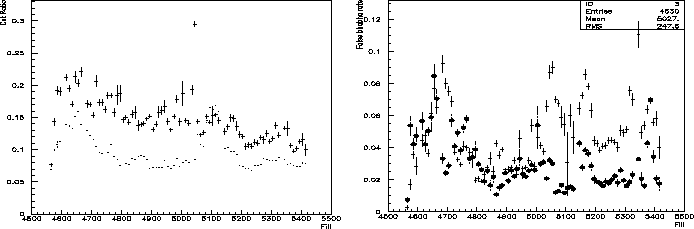
Fortunately the bhabha process is very symmetric and we can impose strict cuts [9] that remove most of the background. The first cut is an energy cut as the electron and positron should have the same energy as the beam. This is taken as a circular cut 23% away from beam energy in the joint energy area of the two bhabha modules. As the electron and positron fly back to back it is also possible to confine them in a specific  x and y region in the strip planes. This cut becomes elliptical, as a quadrupole in front of the VSAT is focusing in Y and defocusing in X. The ratio of both these cuts is shown if fig 4.3, where the crosses originate from the energy cut and the dots from the X and Y cuts.
 |
Even though these two cuts are very effective, some background still resides within the bhabha peak. This background has to be subtracted from the bhabha sample afterwards, as it cannot be cut away directly. As there is no false bhabha trigger anymore these accidental have to be estimated from the single electron trigger.
Three different methods [9] are used to estimate the false bhabha rate, all of which are more or less relative. They are therefore normalized among each other and finally calibrated with help of the STIC luminosity. The rate of subtracted false bhabhas to real bhabhas can be seen for both modules during 1998 in figure 4.4. The curves separate around fill 5050, this is a result of a small leak in the LEP ring and a change of the beam optics.