


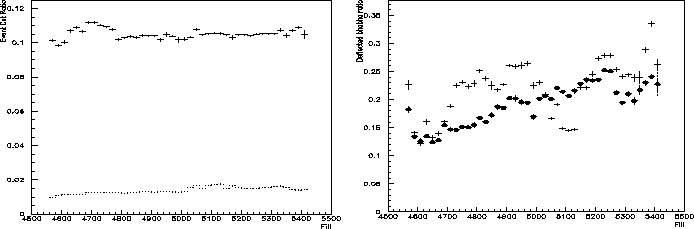
There are a number of edges that is critical for the VSAT analysis. First of all there are four edges that limit the detector area in each module. If a particle hits any of these it is not possible to reconstruct the initial position of the particle shower. This also destroys the energy measurement, as this has to be corrected for energy shower leakage out from the detector walls. All particles that hit the detector edges are thus removed from the analysis. The fraction of all events removed by this cut can be seen as crosses in figure 4.5.
In front of the VSAT a flange is mounted on the beam pipe, this shadows the outer part of the detector and not all of the detector area can be used. Furthermore particles can interact with the edge and loose energy. For the single electron background this is not a problem, as it is only the background properties at the detector that are of interest. If however one(or both) of the particles in a Bhabha event interact with the flange, it will loose part of its energy and the Bhabha event will be removed by the energy cut.
 |
This is in it self not a mayor problem as VSAT only measures relative luminosity, and the decrease in cross section due to this effect is small. The events caught by the energy cut is however used to estimate the false bhabhas that need to be subtracted from the bhabha sample. If this cut has an excess of events due to the flange bhabhas the false bhabha estimation will be too big.
A general cut on the outer edge(X > 8cm) of the active detector area is imposed on the data to avoid most of these events. The bhabha cross section is very small in this region(fig 2.4) and thus little statistics is lost. The second cut is done within the energy cut, sorting out the true background from the flange bhabha sample. The ratio between these are shown for both diagonals in figure 4.6.