


There are three types of gamma-gamma analysis that can be performed in the VSAT environment - no tag, single tag and double tag. Here tagging refers to a hit in the VSAT detector, naturally the no-tag branch is of no interest here as no VSAT data is present. For single tag analysis the off-momentum electrons is the dominating background process.
From the gamma-gamma collisions, there are two types of events that
can be created: either a hadronic system is generated with a number of
hadronic tracks in the DELPHI detector, or a pair of
leptons(
e+e-,
 or
or

 ). The leptonic process
has about 10 times higher cross section, but is unfortunately rather
difficult to study. These leptonic events are visible in the DELPHI
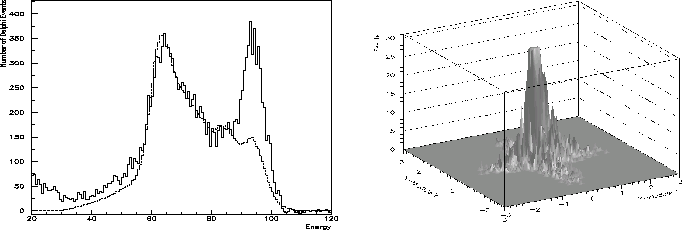
event sample as an extra peak above the off-momentum background(fig 4.7).
). The leptonic process
has about 10 times higher cross section, but is unfortunately rather
difficult to study. These leptonic events are visible in the DELPHI
event sample as an extra peak above the off-momentum background(fig 4.7).
During LEP I the bhabha process was clearly the dominating background for double tag analysis, and little attention was needed on the false bhabha sample. For LEP II this situation has changed, now the off-momentum background can produce false bhabha trigger rates up to half of the bhabha rate(see fig 4.3). The bhabha process is very clean and this background can easily be cut away with a few simple cuts, the off-momentum background is much harder to deal with.
 |
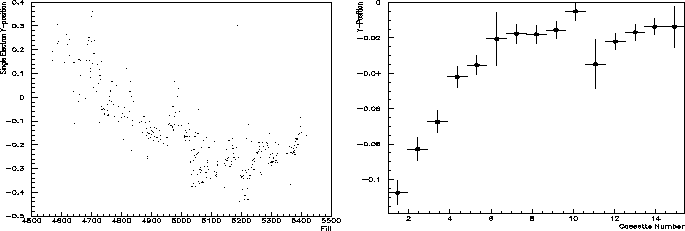
The only way to enclose the off-momentum background, is to define borders in the Y-space in which the off-momentum background is confined. This heavily varies according to the position, tilt and optics of the beams in the LEP ring. This results in both large long term variations and rapid fluctuations within a fill(fig 4.9 and 4.10). To make the cuts as effective as possible it is therefore necessary to adjust them for each cassette, as smaller divisions would make the positioning too uncertain.
For single tag events it is only possible to make a one dimensional cut in the Y-space. In the outer modules the single electrons are very well confined in a small region and a narrow cut can be used. For the inner modules the distribution is wider(fig 4.2), but the rate is on the other hand lower. For gamma-gamma events the whole energy deposition in DELPHI and VSAT is summed. If the sum is bigger than the beam energy, the particle in VSAT naturally cannot originate from the collision at the interaction point. This cut also removes more background from the outer modules as the energy of the off-momentum electrons is generally higher there.
 |
For double tag analysis the situation is a bit better, first of all the signal to background ratio becomes higher. The bhabha process is well known and can be eliminated without any mayor problem, with a small loss of the gamma-gamma cross section. The single electrons can be confined with a two dimensional cut in the Y-space region(see fig 4.8), which makes the relative Y-space available for analysis bigger. The energy cut for the total energy sum also becomes more effective as more particles are added together.