


To calculate the probability that an off-energy electron is recorded
together with a physics event, the same basic selection of events
as in the VSAT study was used, i.e., the events had to have one
shower in each calorimeter
with
2.5o <  < 8o and
0.97 < Ee/Ebeam < 1.05.
The angle between the two showers had to be larger than
179.85o.
A third shower was required in the event and this shower has to be
separated by at least
45o in azimuth from the closest shower.
The angular requirements meant that radiative Bhabha events
with a photon energy of at most
< 8o and
0.97 < Ee/Ebeam < 1.05.
The angle between the two showers had to be larger than
179.85o.
A third shower was required in the event and this shower has to be
separated by at least
45o in azimuth from the closest shower.
The angular requirements meant that radiative Bhabha events
with a photon energy of at most  8 GeV could survive
the selection; the final sample of Bhahbas + an off-energy electron
was selected by requiring the third shower to have an energy
larger than 10 GeV.
8 GeV could survive
the selection; the final sample of Bhahbas + an off-energy electron
was selected by requiring the third shower to have an energy
larger than 10 GeV.
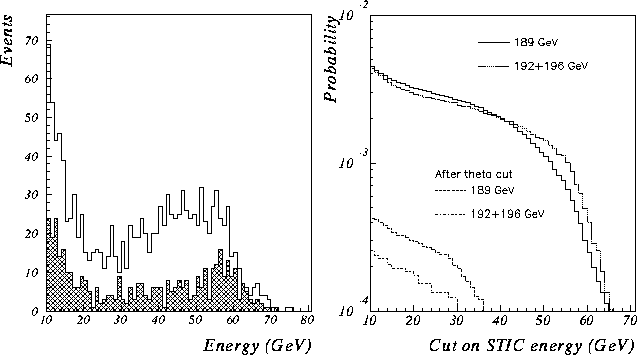 |
The energy distribution of the third shower in the selected events are shown in Figure 13 for both 1998 and 1999 high energy data. The probability of an off-energy electron in STIC as a function of an energy-cut is also shown in Figure 13. The probabilities in 1998 and 1999 are very similar.
The most effective way of removing showers from off-energy
electrons is not by an energy-cut but by a cut on the polar angle.
By requiring
> 3o, most
of the background in the horizontal plane is rejected.
The probability of having an electron after this -cut
is given in Table 7 and Figure 13
and it can be seen that the cut reduces the background by at least one
order of magnitude.
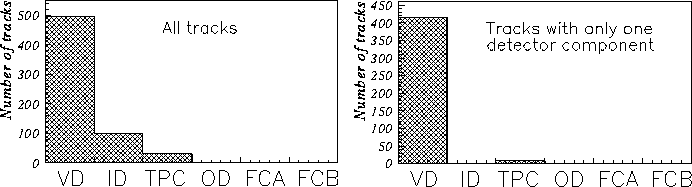
One surprising observation is that more than a third of the events (36% in 1998D and 43% in 1999B) are accompanied by charged tracks. This is in contrast to Bhabha events without off-energy electrons, where less than 1% of the events are accompanied by charged tracks. Most of the tracks in the off-energy electron sample survive the standard cuts on impact parameters and momentum error and are not concentrated in the forward region. They are, however, short (average length = 27 cm) and have a low momentum (average p = 0.4 GeV). A study of the detectors used in the reconstruction of the tracks (Figure 14) showed that most of the tracks are seen in the VD only.
 |
 [%]
[%] > 3o[%]
 0.013
0.013